Korea Slips to Third Place as Regional HQ
Destination,
AMCHAM
Business Survey Points to Regulatory and Labor Issues
Korea is
overtaken by Hong Kong, signaling a shift in regional competitiveness
AMCHAM to
outline policy recommendations in upcoming Business Environment Insight Report
April 15, 2026
- The American Chamber of Commerce in Korea (AMCHAM; Chairman and CEO James
Kim) today released the results of its 2026 Business Environment Survey,
revealing that Korea has fallen to third place as a preferred regional
headquarters (RHQ) destination in Asia Pacific, now trailing both Singapore and
Hong Kong. Korea had consistently ranked second after Singapore over the past
five years since 2022, but fell behind Hong Kong in this year’s survey.
The survey
results clearly found that while global companies view Korea as a stable
market, there is a strong perception among global companies that structural
challenges - particularly in regulatory and labor frameworks - are limiting
Korea’s competitiveness at a time of intensifying regional competition for
investment and secure regional headquarters.
The overall
business sentiment remains relatively positive, with a net positive response
rate of 23.4%. However, companies appear to be adopting a more conservative
approach in hiring and investment strategies. Nearly half of respondents
(46.9%) indicated that they plan to maintain current investment levels, and
over 60% expect no change in workforce, signaling a more pronounced preference
for stability-focused, conservative management approach amid ongoing
uncertainty.
At the same
time, Korea’s regulatory environment continues to be viewed as a significant
burden. A total of 68.8% of respondents describing it as “restrictive” or “very
restrictive,” suggesting that current regulatory conditions are widely seen as
a substantial constraint on business activities. This perception is also being
interpreted as a key factor behind Korea’s declining attractiveness as a
regional headquarters location.
In terms of
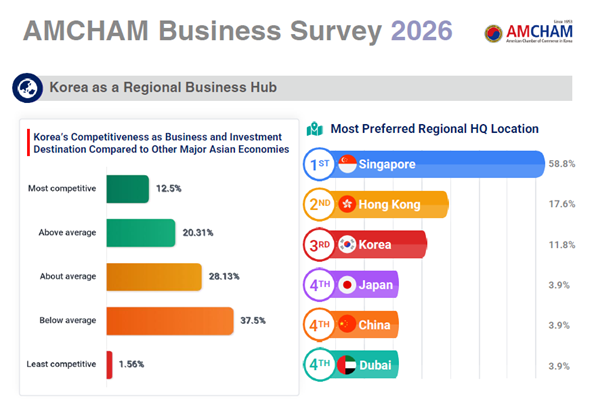
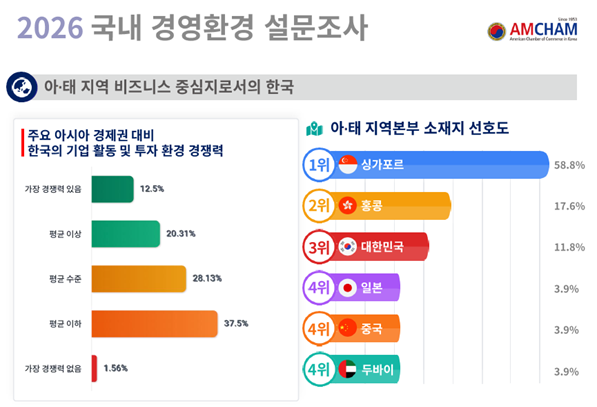
RHQ competitiveness, Korea ranked third (11.8%), well behind Singapore (58.8%)
and Hong Kong (17.63%), underscoring a clear shift in regional preference. This
aligns with broader perceptions of Korea’s competitiveness as a business and
investment destination, where a significant share of respondents assessed Korea
as average or below average compared to other major Asian economies.
Respondents
identified labor policy and labor market flexibility (71%) and Korea-unique or
globally misaligned regulations (61%) as the most significant barriers to
attracting regional headquarters, followed by legal risks for management and
regulatory uncertainty. These factors are not only affecting current investment
decisions but also shaping long-term strategic planning.
The survey
further highlights that these constraints extend to future growth sectors.
Respondents emphasized the need for reforms in data access, cross-border data
transfer regulations, and greater clarity in AI regulation and governance, as
well as improved access to cloud infrastructure and AI talent.
In addition,
respondents assessed Korea’s readiness for MSCI Developed Market inclusion as
mixed. 36% indicated that Korea is “ready or on track,” while 39% said it is
“partially ready,” and 25% responded that it is “not ready or not applicable.”
Respondents
identified key areas for improvement, including regulatory transparency,
consistency and predictability, alignment with global standards, and fair and
open market access for international firms.
AMCHAM
Chairman & CEO James Kim said, “Korea’s drop to third place as a regional
headquarters destination is a disappointing outcome, but it is also a clear
signal that more needs to be done to strengthen its competitiveness. Korea
remains a stable and resilient market with strong growth potential, and with
improvements in regulatory predictability and labor market flexibility, it is
well positioned to regain its standing.”
He added, “As
global competition to attract investment and regional headquarters intensifies,
this is a critical window to advance practical, globally aligned reforms.
AMCHAM will continue to engage closely with key stakeholders and will present
concrete policy recommendations in its upcoming annual Business Environment
Insight Report.”
AMCHAM will
continue to engage closely with government stakeholders and industry leaders to
advance policy dialogue and support reforms that enhance Korea’s attractiveness
as a regional headquarters, financial hub, and innovation ecosystem.
In line with
these efforts, AMCHAM will host its upcoming “Doing Business in Korea” policy
seminar on April 21, where key findings from this survey will be discussed
alongside policy priorities to improve the regulatory environment and
investment climate.
###
한국, 아·태
지역본부 선호도 3위로
하락…홍콩에 밀려
주한미국상공회의소 「2026 국내
경영환경 설문조사」 결과
발표
규제·노동
구조적 제약에 경쟁력
약화…이달 말
연례 「국내 비즈니스
환경 인사이트 리포트」
통해 정책 제언
제시 예정
2026년 4월 15일 - 주한미국상공회의소(암참; 회장 겸 대표이사
제임스 김)는
「2026
국내 경영환경 설문조사」
결과를 발표하고, 한국이
아·태 지역본부(RHQ) 선호도에서
싱가포르와 홍콩에 이어 3위를 기록한 것으로
나타났다고 밝혔다. 한국은 2022년
이후 싱가포르에 이어
줄곧 2위를 유지해
왔으나, 이번 조사에서
홍콩에 뒤처지며 순위가
하락했다.
이번 조사에서는
글로벌 기업들이 한국을
안정적인 시장으로 평가하면서도, 규제와
노동 제도를 중심으로
한 구조적 제약이
경쟁력을 제한하고 있다는
인식이 뚜렷하게 확인됐다. 특히 투자 유치와
지역본부 확보를 둘러싼
역내(域內) 경쟁이
심화되는 가운데, 이러한
요인이 한국의 입지에
직접적인 영향을 미치고
있는 것으로 나타났다.
전반적인 경영
환경에 대한 평가는
순긍정
23.4%로 비교적 양호한
수준을 유지했지만, 기업들의 투자와
고용 전략은 보다
신중해진 모습이다. 응답
기업의
46.9%가 투자 규모를
현 수준으로 유지할
계획이라고 밝혔으며, 60% 이상이
고용 역시 유지할
것으로 응답했다. 이는
대내외적 불확실성이 지속되는
상황에서 보수적인 기조
속 안정 중심의
경영 기조가 강화되고
있음을 보여준다.
규제 환경에
대한 부담도 여전히
큰 것으로 나타났다. 응답자의
68.8%는 국내 규제
환경을 ‘제약적’ 또는 ‘매우 제약적’이라고
평가했으며, 현행 규제
여건이 기업 활동에
상당한 제약 요인으로
인식되고 있음을 확인할
수 있었고 이러한
인식이 지역본부 유치
경쟁력 약화로 이어지고
있는 것으로 분석된다.
지역본부 입지
경쟁력 평가에서는 한국이 11.8%로 3위를 기록하며, 싱가포르(58.8%)와
홍콩(17.6%)과의 격차가
뚜렷하게 나타났다. 이는
한국의 기업 활동
및 투자 환경
경쟁력이 주요 아시아
경쟁국 대비 상대적으로
낮게 평가되고 있음을
보여주는 결과다.
지역본부 유치의
주요 제약 요인으로는 ▲노동
정책 및 노동시장
유연성(71%)
▲한국 특유 또는
글로벌 기준과의 정합성이
낮은 규제(61%)가
가장 많이 지목됐다. 이어 경영진의 법적
리스크와 규제 불확실성
등이 주요 부담
요인으로 꼽혔다. 이러한
요인들은 단기적인 투자
결정뿐 아니라 기업의
중장기 전략 전반에
영향을 미치는 것으로
나타났다.
이 같은
제약은 인공지능(AI) 등
미래 산업 분야에서도
이어지고 있다. 응답
기업들은 데이터 활용
여건, 국경 간
데이터 이전, AI 규제
및 거버넌스의 명확성, 그리고 클라우드 인프라
접근성과 AI
인재 확보와 관련한
제도 개선 필요성을
지적했다.
MSCI 선진국 지수
편입 준비도에 대해서는
평가가 엇갈렸다. 응답자의 36%는 ‘준비가 되어 있거나
순항 중’이라고
평가한 반면, 39%는 ‘부분적으로 준비된 상태’, 25%는 ‘준비가 미흡하거나 해당
없음’이라고 응답했다.
응답 기업들은
주요 개선 과제로 ▲규제의 투명성·일관성·예측 가능성 제고 ▲글로벌 기준과의 정합성
강화 ▲해외 기업에
대한 공정하고 개방적인
시장 접근 보장
등을 꼽았다.
제임스 김
암참 회장 겸
대표이사는 “한국이 지역본부
선호도에서 3위로 내려온
것은 아쉬운 결과이지만, 동시에
경쟁력 강화를 위한
분명한 신호이기도 하다. 한국은 여전히 안정성과
성장 잠재력을 갖춘
시장인 만큼, 규제
예측 가능성과 노동시장
유연성 등 구조적인
과제를 개선한다면 충분히
반등할 수 있다.”고 밝혔다.
이어, “글로벌
기업 유치 경쟁이
더욱 치열해지는 상황에서, 지금이야말로 국제 기준에
부합하는 실질적인 제도
개선을 추진해야 할
중요한 시점이다. 암참은
주요 이해관계자들과 긴밀한
논의를 이어가는 한편, 곧 발간 예정인
연례 『국내 비즈니스
환경 인사이트 리포트』를
통해 구체적인 정책
제언을 지속적으로 제시해
나갈 것이다.” 라고
덧붙였다.
암참은 앞으로도
정부 및 산업계와
긴밀히 협력해 정책
논의를 이어가고, 한국의
지역본부 유치 경쟁력과
금융 허브 도약, 혁신 생태계 강화를
위한 제도 개선을
지속적으로 지원해 나갈
계획이다. 아울러 암참은
오는 4월 21일
연례 「2026 국내
기업환경 세미나」 정책
세미나를 개최하고, 이번
설문조사 결과를 포함한
주요 이슈를 바탕으로
규제 환경 개선과
투자 활성화를 위한
정책 방향을 논의할
예정이다.