AMCHAM Hosts Annual Doing Business in Korea
Seminar,
Highlighting
Pathways to an AI-Driven Economy and Stronger Regional Headquarters Positioning
Freedom 250
special edition brings together government and industry leaders to
strengthen
Korea’s regulatory competitiveness and investment environment
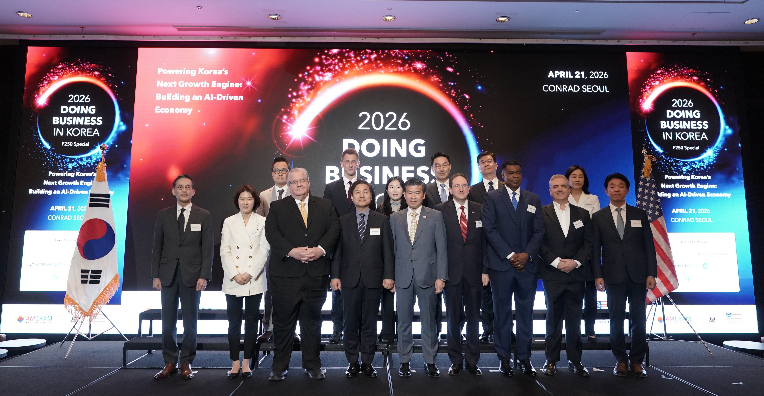
April 21, 2026 - The American Chamber of Commerce in Korea
(AMCHAM Korea) today hosted its annual Doing Business in Korea Seminar 2026 at
the Conrad Seoul, bringing together senior government officials, U.S. and
Korean industry leaders, and policy experts to explore how Korea can accelerate
its transition toward an AI-driven economy and further strengthen its position
as a premier destination for advanced technology investment.
Commemorating the 250th anniversary of the founding of the
United States, this year’s seminar was held as a special “Freedom 250” edition
under the theme “Powering Korea’s Next Growth Engine: Building an AI-Driven
Economy.” The program provided a timely platform to examine how Korea’s
regulatory framework, investment environment, and market access conditions can
evolve to support the development of a globally competitive and trusted AI
ecosystem.
In his opening remarks, AMCHAM Chairman & CEO James Kim
emphasized that AI and advanced industries will play a central role in shaping
Korea’s next phase of growth, underscoring the importance of strengthening
regulatory alignment with global standards and enhancing policy predictability.
“At AMCHAM, we have long said that Korea has the potential
to become a leading regional headquarters hub for global companies - and that
opportunity is more important than ever,” he said. “In a recent roundtable with
President Lee Jae Myung, we discussed the importance of significantly expanding
Korea’s regional headquarters base-from roughly 100 today toward a long-term
vision of 1,000-while strengthening Korea’s competitiveness as a global
business hub. We stand ready to work closely with the Korean Government to help
address regulatory gaps and support a more transparent, predictable, and
globally aligned business environment.”
The seminar featured congratulatory remarks from senior
Korean and U.S. government representatives, reaffirming the strength of the
U.S.-Korea economic partnership and its central role in navigating an
increasingly complex global landscape shaped by technological transformation
and supply chain realignment.
Kim Young-bae, Member of the 22nd National Assembly, said,
“The global landscape is shifting rapidly, and Korea is entering a new phase of
development. As we navigate this shift, there is active dialogue underway on
how to better align regulatory frameworks between Korea and the United States.”
He added, “Our two countries have grown together on the
foundation of a strong alliance, and that partnership will remain central going
forward. Differences may arise, but through continued dialogue and mutual
trust, they can ultimately strengthen the alliance. At the core of this
relationship is economic cooperation, and the role of U.S. companies investing
and operating in Korea has never been more important. Looking ahead, we must
continue working together to build a stronger and more prosperous future.”
James Heller, Charge d’Affaires at the U.S. Embassy Seoul,
underscored the embassy’s readiness to support U.S. businesses operating in
Korea.
In video remarks, Michael George DeSombre, Assistant
Secretary for East Asian and Pacific Affairs at the U.S. Department of State,
said, “The decisions we make today on technology, investment, and partnership
will shape not just the next decade, but the next generation of prosperity and
security for both our countries.”
He added, “As President Lee’s administration has
emphasized, AI will be central to Korea’s economic trajectory, but the vision
extends beyond AI to advanced and emerging technologies such as quantum
computing, biotechnology, and robotics-building on Korea’s strong manufacturing
base in semiconductors, shipbuilding, and batteries. The success of this effort
matters deeply to the United States. Our economies are fundamentally
intertwined?when Korea grows, America grows?and the U.S. government remains
committed to supporting this partnership and ensuring it continues to deliver
shared prosperity and security.”
Sohn Dongkyoon, Deputy Minister of Regulatory Reform at the
Office for Government Policy Coordination, outlined the government’s direction
on regulatory reform, stating, “While Korea has pursued regulatory reform for
decades, the results have not always been fully felt on the ground. To address
this, the new administration is driving a fundamental shift toward a regulatory
rationalization system led directly by the President.”
He added “We are moving toward a more proactive, flexible,
and globally aligned regulatory framework, particularly in response to the
rapid pace of change in emerging industries such as AI. Our goal is to build a
growth-oriented regulatory environment that delivers tangible benefits for both
businesses and the public. To support this effort, we will launch a
public-private task force on regulatory rationalization, bringing together
government, industry, and experts to identify on-the-ground challenges and accelerate
reforms.”
Eunha Clare Kim, Director of Government Affairs at AMCHAM
Korea, also presented key findings from the “AMCHAM 2026 Business Survey and
Insight Report.”
The program examined Korea’s economic outlook and
regulatory reform priorities, as well as opportunities and challenges
associated with AI adoption. Discussions highlighted emerging innovation
models, including the Incheon Free Economic Zone (IFEZ), and explored how
integrated policy and infrastructure frameworks can enable scalable, AI-driven
growth.
Cho Yoon-sun, Attorney at Kim & Chang, said, “Adopting
AI is like navigating a vast ocean strewn with the reefs of risk. Only by
building holistic governance guided by an accurate compass (risk management),
carried by a seaworthy vessel (technical security), and commanded by an
experienced captain (leadership) can we avoid running aground.”
Son Hye-young, Director of Incheon Free Economic Zone
(IFEZ), added, “Through the IFEZ AI City model, we aim to bring together
regulatory innovation, global open innovation, and real-world testing
infrastructure to position Incheon as a leading global hub for AI-driven
innovation.”
Representatives from leading global companies, including
Corning, Onsemi, and Visa, provided on-the-ground perspectives on doing
business in Korea, addressing key regulatory and non-tariff barriers as well as
opportunities to further enhance Korea’s investment environment.
“Korea has strong potential to lead the AI era, supported
by its dynamic industrial ecosystem and outstanding talent,” said Vaughn Hall,
President of Corning Precision Materials and Korea region. “Corning is also
continuing to drive innovation by building on these opportunities, and we
expect that stronger public-private collaboration will play an important role
in enhancing AI competitiveness.”
Lucas Lee, Head of Korea Sales at Onsemi, said, “As Korea
advances its AI ambitions, the key challenge lies in delivering efficient and
reliable power across the entire system, from data centers to electric
vehicles. Onsemi supports Korea’s AI and EV growth through power semiconductor
technologies that enable smarter energy use, electrification, and resilient
infrastructure.”
A dedicated session titled “‘Buy America’ and trusted
supply chains” examined how strengthened U.S.-Korea collaboration can support
resilient, rules-based trade while unlocking new avenues for growth. The
session highlighted AMCHAM’s Buy America initiative, launched in 2025, as a
platform to promote trusted bilateral partnerships and supply chain resilience.
In particular, a case study featuring PTC, an AI-driven
company collaborating with AMCHAM under a memorandum of understanding (MOU),
demonstrated how U.S.-Korea industrial cooperation can translate into tangible
outcomes in AI-enabled manufacturing and advanced industries. Alex Kim, Vice
President and Korea General Manager at PTC Korea, said, “South Korea uniquely
combines world-class manufacturing capabilities with advanced digital
technologies. AI is the key enabler that connects these strengths to drive both
productivity and innovation. With clear data policies and a predictable
regulatory environment, global investment and collaboration will accelerate
further.”
The seminar concluded with a panel discussion moderated by
Chung Ji-eun, CEO & Founder of CODIT, on “Building the Policy Foundations
for Korea’s AI-Driven Economy.” Industry leaders exchanged views on priority
reforms, public-private cooperation, and measures to reinforce Korea’s position
as a regional hub for AI and emerging technologies.
AMCHAM emphasized that the seminar served as a key platform
to advance dialogue on regulatory and market access issues affecting U.S.
companies, while identifying policy directions to strengthen Korea’s global
competitiveness in AI and advanced industries. AMCHAM reaffirmed its commitment
to working closely with government and industry stakeholders to further enhance
Korea’s business environment and deepen U.S.-Korea economic cooperation.