LG
CNS unveils PhysicalWorks to accelerate industrial robot deployment
By Lee Gyu-lee, The Korea Times - LG CNS
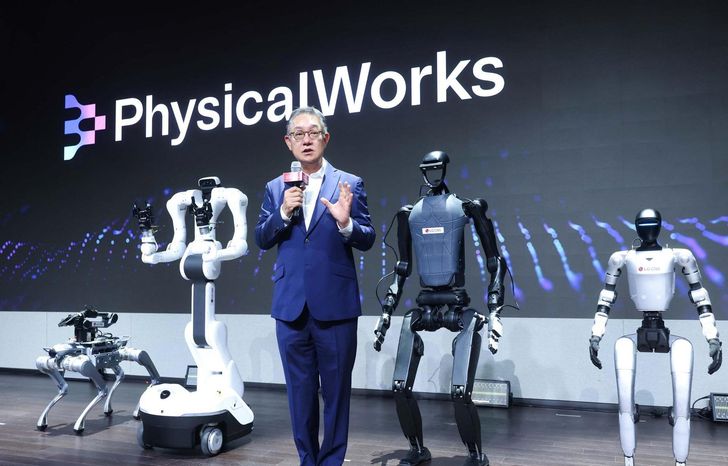
unveiled PhysicalWorks on Thursday, an integrated robot transformation platform
that cuts industrial robot deployment times from several months to one or two
months, as the company escalates its push into physical artificial intelligence
(AI).
PhysicalWorks integrates the entire
cycle of robot operations —training, verification, deployment, operation,
control and management — marking the first time a Korean company has launched
an end-to-end robot platform under its own brand.
"Robots are evolving beyond simple
automation equipment into entities that actually perform production and
operations," LG CNS CEO Hyun Shin-gyoon said during its media event to
introduce the platform at LG Science Park in western Seoul.
“The essence of robot transformation
isn't about individual robot performance, but establishing a framework for
field-specific training, validation and unified operations … LG CNS aims to
partner with clients through their entire robot transformation, leveraging
industrial expertise and AI integration capabilities.”
Emphasizing the importance of integrated
systems for robot deployment and operations, Hyun introduced two core
platforms: PhysicalWorks Forge and PhysicalWorks Baton.
PhysicalWorks Forge supports the full
process from collecting robot training data to validating robots in virtual
simulations and deploying them into real-world industrial environments.
Rather than relying solely on repetitive
human demonstrations for training, the platform uses AI-generated simulation
data in 3D virtual environments replicating actual workplaces and workflows,
enabling faster data collection.
The platform also automates data
refinement with AI that selectively filters and processes useful robot training
data, such as identifying successful object-grasping motions while removing
unnecessary sequences to improve learning efficiency.
The company explained that this platform
will cut the time required to train and deploy robots to one or two months.
Meanwhile, PhysicalWorks Baton serves as
an orchestration platform that standardizes operational data and control
interfaces, allowing companies to manage multiple robots of different types or
makes within a unified system.
Using mathematical optimization and
agentic AI, it also allocates tasks, optimizes robot traffic routes and adjusts
workflows in real time based on operational conditions.
LG CNS said for operations managing 100
autonomous mobile robots or automated guided vehicles, Baton is expected to
improve productivity by more than 15 percent while reducing operational costs
by up to 18 percent.
Forge and Baton are designed to operate
in a continuous feedback loop, where operational data collected through Baton
is reused to further train and refine robots through Forge.
Since launching in March, Forge is
currently running about 20 robot proof-of-concept projects with clients, while
Baton manages four robot types, patrol, barista, cargo-handling and cleaning,
in Busan's smart city pilot project.
The company explained it expects
tangible results within two years.
"We plan to deploy in logistics and
manufacturing first, then develop industry-specific products and expand to
other verticals,” said Lee Jun-ho, LG CNS’ senior vice president of smart
logistics & city business division.
Source: https://www.koreatimes.co.kr/business/tech-science/20260507/lg-cns-unveils-physicalworks-to-accelerate-industrial-robot-deployment