Hyundai Motor's annual capacity to widen by 1.2 mil. by
2030: CEO
Carmaker bets big on China, India as next major revenue
areas
By Lee Min-hyung, The Korea Times - Hyundai Motor will
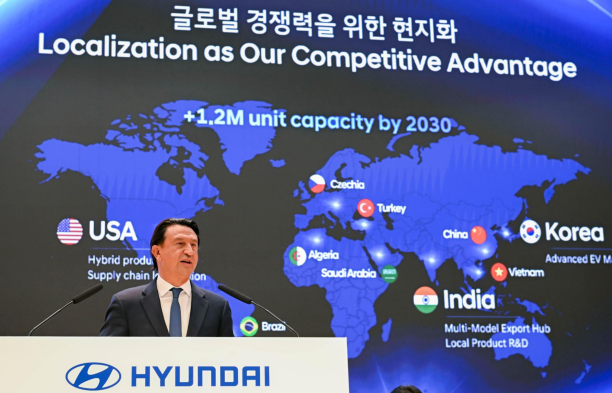
expand its annual production capacity by 1.2 million vehicles by 2030 by
accelerating its localization strategy tailored for each region, the firm’s CEO
Jose Munoz told investors during its regular shareholders’ meeting Thursday.
The renewed vision comes as the global auto industry
undergoes a major paradigm shift into electrification. The global trade
uncertainty — triggered mostly by the imposition of auto tariffs from the
United States — also comes as a lingering risk factor to the Korean carmaker.
However, Hyundai Motor said it identifies the industrial
transition and trade risk as major opportunities to widen its global sales.
“With Hyundai Motor Group Metaplant America ramping to full
capacity, hybrid production being added to our U.S. manufacturing footprint,
and new production bases planned in India, Saudi Arabia and Vietnam, we will
produce more vehicles closer to where our customers live,” Munoz said.
“We will expand our global annual production capacity by
1.2 million units by 2030, and this is how we turn trade challenges into
structural advantages.”
The carmaker placed its strategic focus on executing
specific localization strategies for each market.
Starting from 2027, Hyundai Motor said it will introduce
its extended range electric vehicles (EREVs) with more than 600 miles (965
kilometers) of driving range in North America. EREVs are cars with
high-performance batteries and motors. Their engines are used only for charging
batteries.
North America is the most strategically important market
for the carmaker, as the region accounts for the largest portion of its total
global exports.
The company also shared its plans to launch its first
body-on-frame midsized pickup truck before 2030 in the region where demand for
commercial vehicles remains strong.
Hyundai Motor has also identified China and India as the
carmaker’s two major revenue areas. In China, the carmaker plans to launch 20
new models for the next five years.
“We have already introduced the Elexio electric SUV, with a
C-segment electric sedan to follow,” he said. “Our goal is 500,000 annual sales
there — more than double our current volume.”
For the Indian market, the carmaker will launch a total of
26 new models by 2030 by investing $5 billion (7.53 trillion won).
“We will launch India’s first locally designed, engineered
and manufactured electric SUV by 2027,” Munoz said. “Hyundai Motor will also
bring Genesis to India in the same year.”
On the software front, the carmaker promised to continue
deepening ties with globally renowned tech firms in areas such as artificial
intelligence (AI) and autonomous driving.
“Our collaboration with Nvidia, our investments in 42dot
and Motional, our partnership with Waymo and our commitment to building an AI
data center in Korea are all part of our efforts to secure this technological
competitiveness,” he said.
“We are pursuing multifaceted collaborations to lead in the
most consequential technology race of our era.”
Source: https://www.koreatimes.co.kr/business/companies/20260326/hyundai-motors-annual-capacity-to-widen-by-12-mil-by-2030-ceo