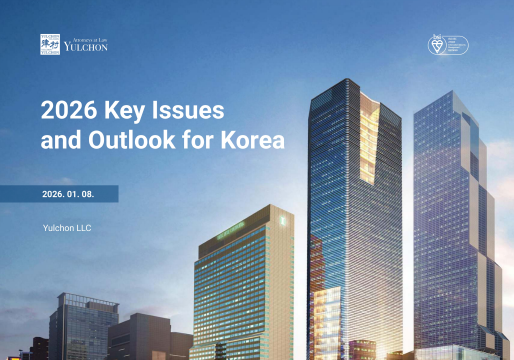
2026 Key Issues and Outlook for Korea
Yulchon - 2026 marks a turning point—a year in which
structural changes across politics, the economy, and industry begin to take
concrete form.
The ninth nationwide local elections on June 3 will serve
as the first public assessment of the current administration one year after its
inauguration. Depending on the outcome, the elections may influence the pace
and direction of policy, as well as the evolving allocation of roles between
the central and local governments.
From an economic and corporate governance perspective, 2026
is expected to see the full-scale application of legislative and policy
measures with material implications for corporate governance and business
judgment. These include amendments to the Commercial Act driven by capital
market value-up initiatives—such as the expansion of directors’ fiduciary
duties and, subject to legislative approval, the mandatory cancellation of
treasury shares—as well as the “Yellow Envelope Act.” As these frameworks are tested
in practice for the first time, related legal issues and their implications for
corporate management will remain at the forefront.
At the industry level, AI is emerging as a core growth
sector under an increasingly supportive legal and policy environment, anchored
by the AI Framework Act and Korea’s ambition to become one of the world’s top
three AI leaders. Semiconductors, as a foundational industry for AI, are also
expected to remain an important growth engine. Meanwhile, amid the entrenchment
of U.S.–China tensions and ongoing geopolitical risks in Ukraine and the Middle
East, global demand for the defense industry, along with sustained policy
attention, is likely to continue. In parallel, companies will face a complex
set of legal risks in 2026, including expanded overseas investment in
connection with U.S. investment commitments, regulations aimed at preventing
technology leakage, and heightened foreign exchange volatility.
Against this backdrop, Yulchon LLC presents its report,
“2026 Issues and Outlook for Korea,” which provides a comprehensive analysis of
(i) domestic and foreign policy variables, (ii) key policy issues relating to
AI, capital markets, and core technologies, and (iii) key industry-specific
developments across sectors including semiconductors, finance, real estate,
labor, shipbuilding, defense, and energy.
Source: https://www.yulchon.com/en/resources/publications/newsletter-view/42568/page.do