AMCHAM
Calls for Predictable Healthcare Policy Action in Korea
17th
Innovation Seminar Focuses on Pricing Reform, Vaccine Ecosystem, and AI
Healthcare
By Editor
Lee Kwang-soo, BusinessKorea - The American Chamber of Commerce in Korea
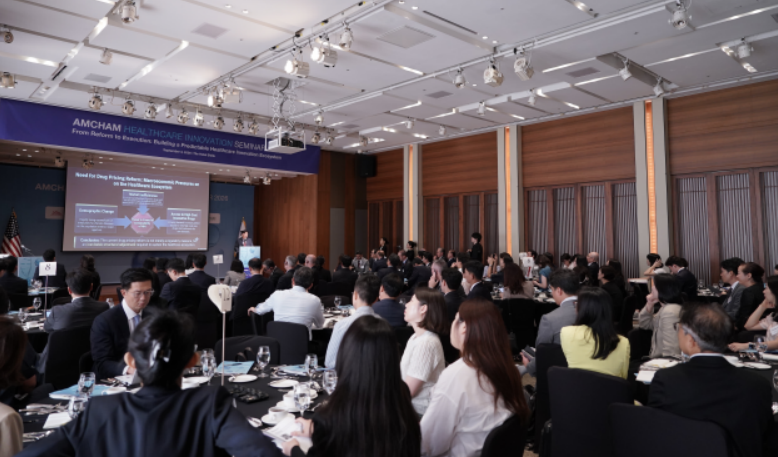
(AMCHAM) hosted its 17th Healthcare Innovation Seminar at Hotel Shilla Seoul on
Sept. 3, bringing together approximately 150 senior government officials,
business leaders, and healthcare experts from South Korea and the United States
to advance practical dialogue on the future of healthcare innovation and
policy.
Under
the theme "From Reform to Execution: Building a Predictable Healthcare
Innovation Ecosystem," the seminar examined how South Korea can translate
healthcare reform into meaningful outcomes for patients, innovation, and
investment. Against the backdrop of ongoing bilateral discussions on regulatory
competitiveness and non-tariff barriers, participants emphasized predictable
policy implementation, greater alignment with global standards, and an
innovation-friendly regulatory environment to strengthen the nation's appeal as
a destination for global healthcare investment.
The
agenda centered on three core policy priorities: successfully implementing the
Ministry of Health and Welfare's pharmaceutical pricing reforms announced in
late 2025; strengthening Korea's vaccine ecosystem; and establishing effective
policy pathways for AI-enabled healthcare and precision medicine. Across all
sessions, attendees explored policy refinements and public-private
collaboration needed to expand patient access, recognize the value of
innovation, accelerate the adoption of advanced medical technologies, and
strengthen Korea's long-term healthcare competitiveness.
"Korea
has made meaningful progress on healthcare reform. The priority now is to
translate that progress into tangible results through implementation that is
predictable and transparent, expands patient access, and supports continued
innovation," said AMCHAM Chairman & CEO James Kim. He noted that
pricing reform, vaccines, and AI will play a central role in shaping the future
of healthcare, adding that sustained government-industry dialogue and
U.S.-Korea collaboration will allow both countries to create new opportunities
together.
Key
government and legislative leaders voiced strong support for deepening
cross-border cooperation. Lee Man Hee, Chair of the National Assembly’s Health
and Welfare Committee, emphasized via video message that policies must evolve
alongside medical breakthroughs, stating that cross-border collaboration is
essential to achieve tangible results. Kang Cheong Hee, President of the
National Health Insurance Service, outlined plans to build a more innovative
national health insurance system leveraging AI and data. In written remarks,
Second Vice Minister of Health and Welfare Lee Hyung-hoon highlighted
government efforts to shorten reimbursement listing timelines for rare disease
treatments and align regulations with global standards. James Heller, Deputy
Chief of Mission at the U.S. Embassy in Seoul, also underscored the vital role
of U.S.-Korea partnership in strengthening health security.
The
seminar’s three panel sessions addressed actionable steps across the priority
sectors:
Pharmaceutical
Pricing Reform: Discussions focused on implementing the late-2025 pricing
reforms to balance patient access, value recognition for innovative medicines,
and healthcare financing sustainability. Keynote presenter Cho Won Jun
(Democratic Party of Korea) joined panelists including Kang Joonhyuk (Ministry
of Health and Welfare), Christian Rodseth (Johnson & Johnson), and Hye
Young Lee (BMS Korea). Lee noted that swift implementation and expanding
successful initiatives across therapeutic areas could yield visible outcomes
within two to three years.
Vaccine
Ecosystem and Prevention: Panelists examined shifts toward a life-course
immunization framework to address rapid demographic aging and public health
challenges. Jung Tong Ryoung (KDCA) discussed legislative reforms to the
national immunization program, while Chan-Woo Song (Pfizer Korea) and Professor
Kevin Kee-jong Hong (Gachon University) emphasized the expanding potential of
mRNA technology and the need to connect global collaboration with domestic
R&D.
AI-Enabled
Healthcare and Precision Medicine: Experts examined policy pathways to
integrate cutting-edge diagnostics and digital tools into clinical practice.
Chris Thiem (BMS APAC) discussed AI as a transformation catalyst, while Divya
D. Mehta (Guardant Health AMEA) advocated for a flexible regulatory environment
that accommodates technological innovation from overseas testing laboratories.
Michael Titus (Eversight) praised AMCHAM’s role in bridging government and
private sector leaders to establish Korea as a dominant force in global
healthcare innovation.
Participants
concluded that transparent policy execution, international regulatory harmony,
and robust public-private engagement are essential foundations for sustainable
growth across Korea’s healthcare sector.
Source:
https://www.businesskorea.co.kr/news/articleView.html?idxno=276148