Tariffs shouldn't define Korea-U.S. partnership: AMCHAM
chief
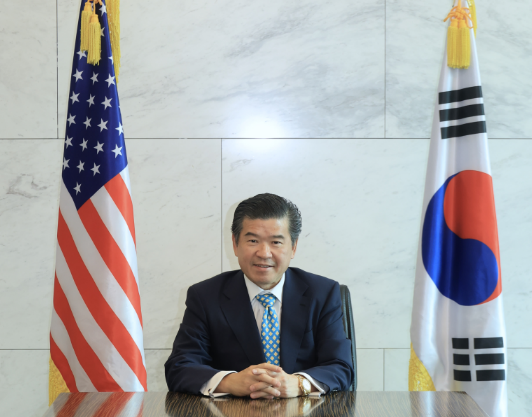
By Lee Jung-woo, Aju Press - A fresh round of U.S. tariffs
may cloud the Korea-U.S. economic relationship, but they should not define one
of the world's deepest strategic business partnerships, according to James Kim,
Chairman and CEO of the American Chamber of Commerce in Korea.
With Seoul and Washington seeking closer cooperation in
artificial intelligence, semiconductors, shipbuilding and advanced
manufacturing, Kim argued that sustained dialogue—not escalating trade
measures—offers the best way to resolve disputes.
"Direct engagement and constructive dialogue offer the
best path to resolving complex trade issues," Kim said in an interview
with AJP at AMCHAM Korea's office in Seoul.
"Prolonged trade disputes or escalating trade measures
can create unintended consequences for companies, workers, consumers and
investors on both sides."
Korean companies have become among the largest foreign
investors in the United States across semiconductors, batteries, energy and
manufacturing, while American companies increasingly view Korea as a strategic
technology and production partner rather than simply a consumer market.
Bilateral goods trade reached an estimated $194 billion in
2025, while the United States recorded an $11.3 billion surplus in services
trade.
"The U.S.-Korea economic relationship is broader,
deeper and more strategic than at any point in its history," Kim said.
"Our economies are deeply integrated, our supply
chains are increasingly interconnected, and our companies are creating value
together across a much broader range of strategic sectors."
That integration also means tariffs rarely stop at the
border.
Higher costs on Korean components ripple through American
factories, investors and consumers, while prolonged uncertainty delays
decisions on new factories, research centers and regional headquarters.
"Trade frictions rarely affect only one side,"
Kim said. "The impact would be felt not only by Korean exporters, but also
by American companies operating in Korea."
Rather than focusing on individual trade disputes, Kim
urged policymakers to keep sight of the broader partnership spanning AI,
defense, energy, biotechnology, shipbuilding and advanced manufacturing.
"The goal should not be to determine who wins a trade
dispute," he said. "It should be to strengthen the long-term
competitiveness of both economies."
Kim also expects bilateral communication to improve with
Michelle Steel expected to arrive in Seoul as the first resident U.S.
ambassador since Philip Goldberg departed in early 2025.
Turning dialogue into access
AMCHAM has increasingly positioned itself as a practical
bridge between governments and businesses.
Its annual Washington Doorknock program brings corporate
leaders to meet U.S. administration officials and lawmakers. This year it
expanded the initiative with K-Doorknock, giving Korean companies investing in
America direct access to senior U.S. policymakers.
From July 13 to 16, an 11-company delegation led by Kim
held more than 30 meetings with White House officials, members of Congress,
business organizations and policy institutions covering AI, semiconductors,
shipbuilding, economic security and advanced manufacturing.
"Our role is not to determine policy outcomes,"
Kim said. "Our role is to help ensure governments and businesses stay
connected, communicate openly and work through issues before they become larger
challenges."
Early engagement is particularly valuable in disputes
involving tariffs, digital regulation and national security, where policy
misunderstandings can quickly escalate.
"Many trade issues become more manageable when there
is early engagement and a clear understanding of business realities," Kim
said.
Korea has strengths—but competition is intensifying
Kim remains optimistic about Korea's long-term investment
appeal, citing its skilled workforce, advanced digital infrastructure and
globally competitive industrial base.
"Korea is one of the world's most sophisticated and
innovative economies," he said.
Yet AMCHAM's 2026 Business Environment Survey also suggests
Korea cannot afford to stand still.
Korea slipped from second to third among preferred
Asia-Pacific regional headquarters locations, behind Singapore and Hong Kong.
Nearly 69 percent of respondents described the regulatory environment as
restrictive or very restrictive.
Kim views the findings as a roadmap rather than a setback.
"The question today is not whether Korea is
competitive, but how it can become even more competitive," he said.
AMCHAM members identified labor-market flexibility,
internationally aligned regulations and greater legal certainty as the top
priorities for reform.
"For businesses making long-term investment decisions,
confidence in the policy environment is just as important as confidence in the
market itself," Kim said.
AI leadership requires global cooperation
Kim believes artificial intelligence presents Korea's
greatest opportunity.
"Korea is exceptionally well positioned to become one
of the world's leading AI economies," he said. "Few countries possess
such a strong combination of technological capability, industrial depth and
digital readiness."
AMCHAM reinforced that message through its AI Forum earlier
this month, where it launched the AMCHAM AI Leadership Council to promote
cooperation on AI infrastructure, cross-border data flows, semiconductor supply
chains and talent mobility.
Kim also dismissed the notion that "sovereign AI"
requires technological self-sufficiency.
"The strongest AI ecosystems will combine robust
domestic capabilities with open international collaboration," he said.
That message comes as Washington continues to raise
concerns over Korean proposals affecting digital platforms, cloud services and
cross-border data transfers.
Kim argued that regulation and innovation should
reinforce—not undermine—each other.
"I do not see fair competition and innovation as an
either-or choice," he said. "A healthy digital economy depends on
both."
From trade to long-term investment
Beyond trade, AMCHAM is working with both governments to
translate ambitious investment commitments into tangible projects.
Following Seoul's pledge to invest $350 billion in the
United States under the Korea Strategic Trade and Investment Deal, AMCHAM has
supported implementation through initiatives such as K-Doorknock, Buy America
and its Doing Business in the U.S. Seminar.
For Kim, those efforts reflect the evolution of the
bilateral relationship.
"My message would be simple: continue investing in the
partnership," he said.
"The U.S.-Korea relationship is one of the world's
strongest and most dynamic economic partnerships. Today, our two countries are
not only important trading partners, but also strategic partners in AI,
semiconductors, advanced manufacturing, energy, biotechnology and the
industries that will shape the future."
Kim, a former chief executive of GM Korea and former
president of Microsoft Korea, said AMCHAM will continue serving as "a
trusted bridge" between the two governments and business communities as
economic ties grow increasingly strategic.
Source: https://www.ajupress.com/view/20260727101654847