U.S. warns Korea of Chinese tech reliance,
regulatory barriers
Washington
official urges Seoul to choose trusted partners, transparent systems
By Park
Jae-hyuk, The Korea Times - The United States is ramping up pressure on Korea
to stop using Chinese technologies and remove regulations deemed unfavorable to
American companies, with a senior U.S. official saying Tuesday that Seoul has
to make a choice in the face of adversaries undermining the alliance.
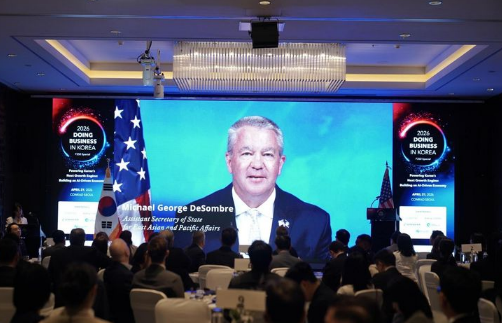
In a
prerecorded video at the American Chamber of Commerce in Korea’s (AMCHAM)
annual Doing Business in Korea seminar in Seoul, Michael DeSombre, assistant
secretary for East Asian and Pacific affairs at the U.S. Department of State,
warned of China’s moves to drive a wedge between Korea and the U.S., calling
the world’s second-largest economy “a regional adversary.”
“The Republic
of Korea has a choice to make,” he said. “I am confident it will continue to
choose trusted partners, transparent systems and technologies that respect
privacy, security and the rule of law.”
Highlighting
the Technology Prosperity Deal signed at the Korea-U.S. summit last October,
the senior diplomat indicated Washington’s intent to leverage the partnership
to curb Beijing’s attempts to use its technologies to increase its influence in
the Indo-Pacific region.
“The dangers
of relying on Chinese models and the Chinese technology stack are real,”
DeSombre said. “Systems built on untrusted infrastructure create
vulnerabilities that can be exploited for surveillance, coercion and control.”
He emphasized
the need for export controls, investment screening mechanisms and supply chain
initiatives, describing them as “essential tools” to protect shared prosperity
and values, not protectionist measures.
The AMCHAM
seminar was held mainly to discuss how Korea’s regulatory framework can evolve
to support the development of a globally competitive and trusted artificial
intelligence ecosystem.
Citing the
operations of Anthropic, OpenAI and Amazon Web Services in Korea, DeSombre
urged the Korean government to meet demands for regulatory clarity, fair market
access and a level playing field if it wants to continue attracting investments
from U.S. tech firms.
His comments
were in line with Washington's claims that Korea’s proposed online platform
regulations and network law are discriminatory toward American companies and
favorable to Chinese firms.
“The question
is whether the regulatory environment will enable that partnership or hinder
it,” DeSombre said. “I am confident that the Republic of Korea will choose the
path that maximizes growth, competitiveness and security.”
James Heller,
charge d'affaires ad interim at the U.S. Embassy in Seoul, said at the seminar
that the conditional approval of Korea's transfer of high-definition map data
to Google signaled the country’s willingness to ensure a transparent,
predictable and level playing field that fully unlocks the potential of the
digital services market.
The remark is
also seen as putting pressure on the Korean government. The government allowed
Google to obtain high-precision map data in February under a number of security
conditions, but the two sides are still narrowing their differences over
technical requirements for meeting those conditions.
At the event,
AMCHAM also shared key findings from the 2026 Business Survey released last
week, which showed that Korea has become less attractive than Hong Kong as a
base for Asia-Pacific headquarters for U.S. companies.
“We stand
ready to work closely with the Korean government to help address regulatory
gaps and support a more transparent, predictable and globally aligned business
environment,” AMCHAM Chairman James Kim said.
Source: https://www.koreatimes.co.kr/business/companies/20260421/us-warns-korea-of-chinese-tech-reliance-regulatory-barriers?utm_source=goat&utm_medium=redirect&utm_campaign=article_legacy_id