Lee pledges market
transparency in meeting with heads of foreign firms
SARAH Kim, Korea JoongAng Daily - President
Lee Jae Myung stressed plans to increase market transparency and alleviate
geopolitical risks so that South Korea can become a top investment destination
in a meeting with executives of foreign companies investing in the country on
Wednesday.
"We will create objective
conditions to make South Korea the world's top investment destination,"
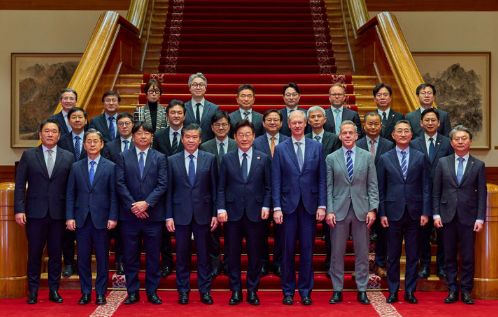
Lee said at the roundtable with representatives of 31 firms and seven chambers
of commerce in Korea at the Blue House in central Seoul. "We're confident
that we can share the future together."
The roundtable provided an opportunity
for the president to listen to the views of the companies and, in return,
request investments that can create more opportunities for young people and
local communities.
The meeting comes as U.S. lawmakers and
officials have indicated dissatisfaction with a Korean investigation into a
massive data leak by e-commerce giant Coupang. Seoul has been criticized over
how it's been handling the U.S.-listed Coupang's data breach, calling it a
discriminatory approach and a political witch hunt.
The Blue House roundtable was attended
by the heads of seven foreign chambers of commerce, including the American
Chamber of Commerce in Korea (Amcham), British Chamber of Commerce in Korea,
China Chamber of Commerce in Korea, Korean-German Chamber of Commerce and
Industry, European Chamber of Commerce in Korea, French Korean Chamber of
Commerce and Industry and Seoul Japan Club.
Other attendees included both executives
of key foreign firms invested in high-tech industries, supply chains and
services including Merck, Renault Korea, Microsoft Korea, Amazon Web Services
Korea and Corning Korea.
Lee noted that foreign direct investment
pledges in South Korea 2025 reached a record high of around $36 billion.
However, he said that the South Korean
market "remains undervalued" and addressed some concerns, such as
geopolitical uncertainties.
He pledged to "avoid unnecessary
military confrontation or tensions with North Korea," stressing that he
intends to maintain stability in the region to ease concerns over geopolitical
risks.
Lee further pledged efforts to enable an
open market and ensure fairness and transparency in the stock market.
"Geopolitical risks on the Korean
Peninsula have improved noticeably, and we will continue to implement
legislative and administrative measures regarding market transparency and
corporate governance," Lee said.
He also stressed Korea will work towards
eliminating unnecessary regulations, reforming corporate governance and
enhancing transparency in the capital markets.
Lee underscored that South Korea is
undergoing a major transition toward high-tech industries, with AI and
renewable energy at the core of this shift.
"It seems that employees around the
world are increasingly preferring South Korea due to various factors, including
cultural, geographic and public safety concerns," Lee said. "The
increasing presence of global companies benefits us and brings happiness to
their employees."
He also addressed Korea's high
electricity prices, acknowledging that "they've recently become more
expensive compared to international standards."
The remarks came after an attendee noted
that Korea's electricity prices are relatively uncompetitive with those of
other regions. Lee said that there is a supply issue and that the "only
way to lower unit prices is to supply renewable energy in large
quantities," promising growth as a key industry for the future.
He also promised to listen to
suggestions from foreign companies and national chambers of commerce in Korea
and actively incorporate them into policy.
"While some challenges remain, I'm
confident that the United States and Korea will reach a win-win outcome,"
James Kim, chairman and CEO of Amcham, said. "I believe that with targeted
labor, legal and tax reforms, Korea can become a true game changer for youth
employment and regional development."
The scheduled roundtable comes a day
after U.S. President Donald Trump, in a surprise move, announced a plan on
social media to increase "reciprocal" tariffs and auto duties on
Korea to 25 percent from 15 percent, taking issue with a delay in Seoul's
legislative process meant to support the implementation of the bilateral trade
deal reached last year.
The move led to rampant speculation on
whether Trump's tariff hike warning was in response to the Coupang probe or
some other dissatisfaction with Seoul.
Kim Yong-beom, presidential chief of
staff for policy, told reporters Wednesday, "We believe the U.S.
dissatisfaction stems 100 percent from the delay in legislation in the National
Assembly," as he addressed the speculation over Trump's announcement.
Kim underscored that Seoul plans to
"explain in detail" the Korean parliament's efforts to pass the
pending special investment bill related to the bilateral trade deal involving a
$350 billion investment pledge by Korea to the United States.
He acknowledged that the parliamentary
process has been discussed between the two countries' trade officials but noted
that "the United States may have felt frustrated" nonetheless. Both
Industry Minister Kim Jung-kwan and Trade Minister Yeo Han-koo are set to hold
talks with their U.S. counterparts soon.
Source: https://koreajoongangdaily.joins.com/news/2026-01-28/national/politics/Lee-pledges-market-transparency-in-meeting-with-heads-of-foreign-firms/2511011