S.
Korea's industry minister engages in dialogue with AMCHAM on economic
partnership
By Park
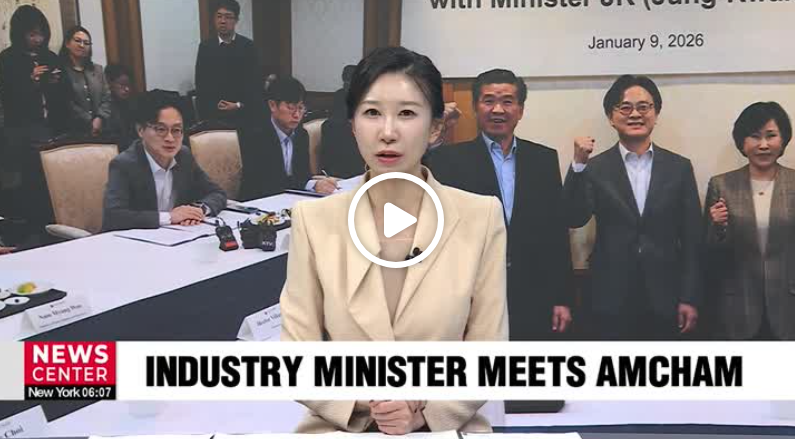
Jun-han, Arirang TV - Industry Minister Kim Jung-kwan met with AMCHAM CEO James
Kim and senior executives from global companies to discuss industrial
cooperation and Korea's investment environment.
Park
Jun-han was there.
Minister
of Trade, Industry and Resources Kim Jung-kwan engaged in an exclusive
high-level closed-door roundtable with the American Chamber of Commerce in
Korea on Friday at the Government Complex in Seoul.
The
meeting brought together the host, AMCHAM Chairman and CEO James Kim, and
senior executives from leading global companies in key sectors, including
semiconductor equipment, energy, pharmaceuticals and biohealth, automobiles,
steel and materials, and financial services.
Minister
Kim said the successful tariff negotiations and sustained U.S. investment in
Korea demonstrate the reciprocal and mutually beneficial nature of the two
countries' investment relationship.
"One
of my most important responsibilities is to ensure that companies here are not
treated any worse than Korean firms when doing business in Korea. I look
forward to your continued and active investment across a wide range of sectors,
including AI data centers, semiconductors, and biotechnology."
AMCHAM
CEO James Kim praised South Korea's successful tariffs negotiation with the
U.S. and applauded Korean companies that swept nearly 60 percent of innovative
awards at the Consumer Electronics Show, CES.
"At
a time when rapid advances in AI and shifting geopolitical dynamics are
reshaping the global landscape, the partnership between Korea and the U.S.
remains more important than ever in promoting economic security and sustainable
growth. The AMCHAM leaders here today represent leading companies at the
forefront of U.S.-Korea cooperation, and they are ready to share practical,
actionable recommendations on how we can unlock Korea's full potential as a
regional hub."
Friday's
closed-door roundtable also addressed the views of industry players on
regulatory streamlining, item-specific tariffs, and incentives for foreign
investment.
Participants
shared firsthand perspectives on key policy challenges, including regulatory
clarification, greater predictability for investors, and stronger cooperation
in emerging and advanced industries.
Source:
https://www.youtube.com/watch?v=2o-MUvj0wiU