Integration into local ecosystem key to
Korean biz's global sustainability: panelists
Panelists say
workforce development, local partnerships and AI key to sustainable overseas
growth
By Nam
Hyun-woo, The Korea Times - Korea's top business leaders from Hanwha, SK and
other major companies highlighted deeper integration into local ecosystems as a
key factor in helping Korean firms evolve from export-driven businesses to
sustainable global players, sharing their experiences and success stories at
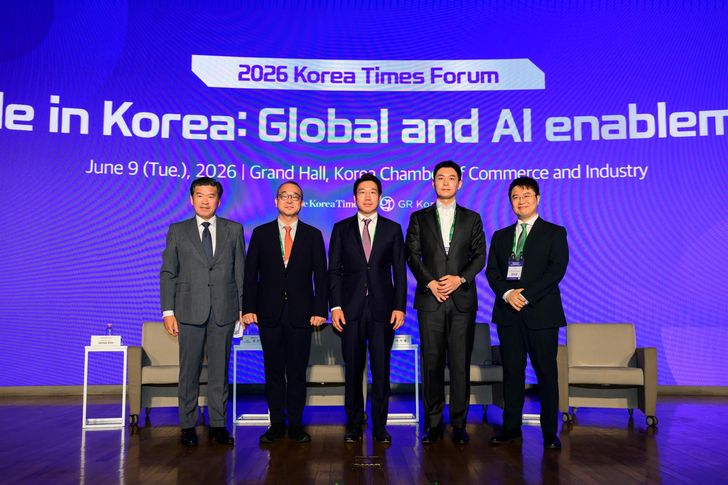
The Korea Times Forum "Made in Korea: Global and AI enablement,"
co-hosted by GR Korea on Tuesday.
During Session
1 of the forum, Hanwha Ocean Head of Management Support Office Jung In-sub, SK
Group Head of Research Park Suk-jung, PTC Korea General Manager Alex Kim and S4
Capital Chairman Sir Martin Sorrell each discussed strategies to help Korean
firms deepen their presence in overseas markets. The discussion was moderated
by American Chamber of Commerce in Korea Chairman James Kim.
“When Hanwha
Ocean was launched in 2023, we believed the biggest risk facing the company was
the cyclical nature of the shipbuilding industry,” Jung said.
“As we
considered how to overcome that challenge, we saw an opportunity in the
weakening competitiveness of the U.S. shipbuilding sector and decided to enter
the market. In high-GDP (gross domestic product) economies like the U.S.,
labor-intensive industries often struggle to remain competitive.”
Jung's
comments are in line with Hanwha Ocean's growing role in U.S. efforts to
rebuild its shipbuilding industry. The shipbuilder, formerly Daewoo
Shipbuilding & Marine Engineering, entered the U.S. market in June 2024
through its acquisition of Philly Shipyard and has since emerged as a key
partner in Korea-U.S. shipbuilding cooperation, as U.S. President Donald Trump
has made revitalizing the sector a policy priority.
Jung said the
company identified three key challenges when it first considered entering the
U.S. shipbuilding market: securing facilities, rebuilding a skilled workforce
and restoring supply chains. He said facilities can be built through investment
but developing workforce and rebuilding supply chains cannot be achieved in a
short period of time.
“Hanwha is
committed to maintaining a long-term presence in the U.S. shipbuilding
industry,” he said. “We are considering sending Korean experts to the U.S. or
bringing American workers to Korea for on-the-job training, with the goal of
developing a skilled workforce. Supply chains are a more complex challenge than
labor, but we believe opportunities will emerge as the U.S. remains committed
to revitalizing its shipbuilding industry."
Hanwha Ocean's
approach reflects a broader shift in the meaning of localization. Rather than
focusing solely on local hiring and procurement, companies are increasingly
expected to pursue a long-term approach encompassing technology transfer,
workforce development, regulatory compliance and cultural integration,
effectively embedding themselves within local industrial ecosystems.
Sorrell also
shared similar views in advising Korean companies seeking to become a global
player. While acknowledging their strengths in exports, manufacturing and
innovation, he stressed that Korean firms need to take a more native approach
to localization in overseas markets.
“Many of the
major Korean companies still rely heavily on Korea-based agencies and
decision-making structures that remain closely tied to headquarters,” he said.
“I think Korean companies have to learn to use native and local management much
more effectively. It may be difficult to trust in create marketing structures
that reflect the local cultures. I'm being very direct about this.”
Sorrell said
the world is likely to face continued fragmentation, persistent inflation and
slower economic growth, requiring companies to become more strategic about
"where they do and what they do."
He then
advised Korean firms to focus their efforts on key regions including North
America, Latin America, the Middle East and Asia.
Park said
Korean companies must secure an overwhelming technological edge while
strengthening buffers against external shocks.
"For the
past two decades, the global economy has operated under a framework in which
the United States consumed and China produced, allowing Korea to benefit from
the resulting expansion in trade," Park said.
"That
framework, however, is becoming increasingly difficult to sustain. The U.S. is
shifting toward a production-oriented economy, while China has made boosting
domestic consumption its top priority."
"In this
environment, Korea must secure a clear technological advantage and build
partnerships that support the joint growth of both of the superpowers. At the
same time, it should strengthen cooperation with countries such as Japan and
Taiwan to enhance its ability to absorb external shocks at the national
level."
PTC Korea's
Kim, meanwhile, said both localization and globalization can be both valid
strategies, but stressed that what ultimately differentiates successful
companies is how quickly they adapt to changing global conditions and turn
strategy into execution.
"Ultimately,
the most important factor for fast execution is eliminating data fragmentation
across organizations," Kim said.
"In
manufacturing, for example, design data often does not align with the
manufacturing data used to implement those designs. As products become
increasingly customized in the AI era, it is critical to ensure that the voice
of the market is connected through a seamless flow of data."
The panelists
agreed that artificial intelligence (AI) transformation is one of the most
significant trends affecting businesses today, stressing the need to secure a
competitive edge through safety, cost reduction, infrastructure expansion and
data optimization.
"There
are two major areas where AI transformation can take place in the shipbuilding
industry: improving safety through smart AI technologies and deploying AI in
upstream processes over the longer term so that we can enhance cost
competitiveness against Chinese rivals," Jung said.
Park said that
SK Group and other Korean companies more broadly view the ongoing
transformation with both urgency and optimism. He stressed the need to first
secure computing resources and build AI infrastructure before expanding into a
broader AI ecosystem.
Kim said “the
success or failure of AI transformation is effectively determined before AI is
even deployed,” arguing that outcomes largely depend on how well companies
prepare and organize their data foundations.
Source: https://www.koreatimes.co.kr/business/companies/20260609/forum-integration-into-local-ecosystem-key-to-korean-bizs-global-sustainability-panelists